If you’re new to aquarium keeping, you’ve probably come across two common pieces of equipment: air pumps and filters. At first glance, they might seem similar — both create movement in the water, and both are important for tank health.
But here’s the truth: air pumps and filters serve very different purposes.
Understanding the difference between the two will help you create a healthier, more stable environment for your fish. In this guide, we’ll break down how each one works, when you need them, and whether you need both.
What Does an Aquarium Filter Do?
A filter is the core life-support system of your aquarium.
Primary Function: Water Filtration
Filters remove waste and toxins from the water through three main processes:
1. Mechanical Filtration
Removes visible debris like fish waste and uneaten food.
2. Biological Filtration
Encourages beneficial bacteria to grow. These bacteria convert harmful ammonia into less toxic substances.
3. Chemical Filtration
Uses activated carbon or other media to remove dissolved impurities and odors.
Without a filter, ammonia levels can rise quickly, creating a dangerous environment for fish.
What Does an Air Pump Do?
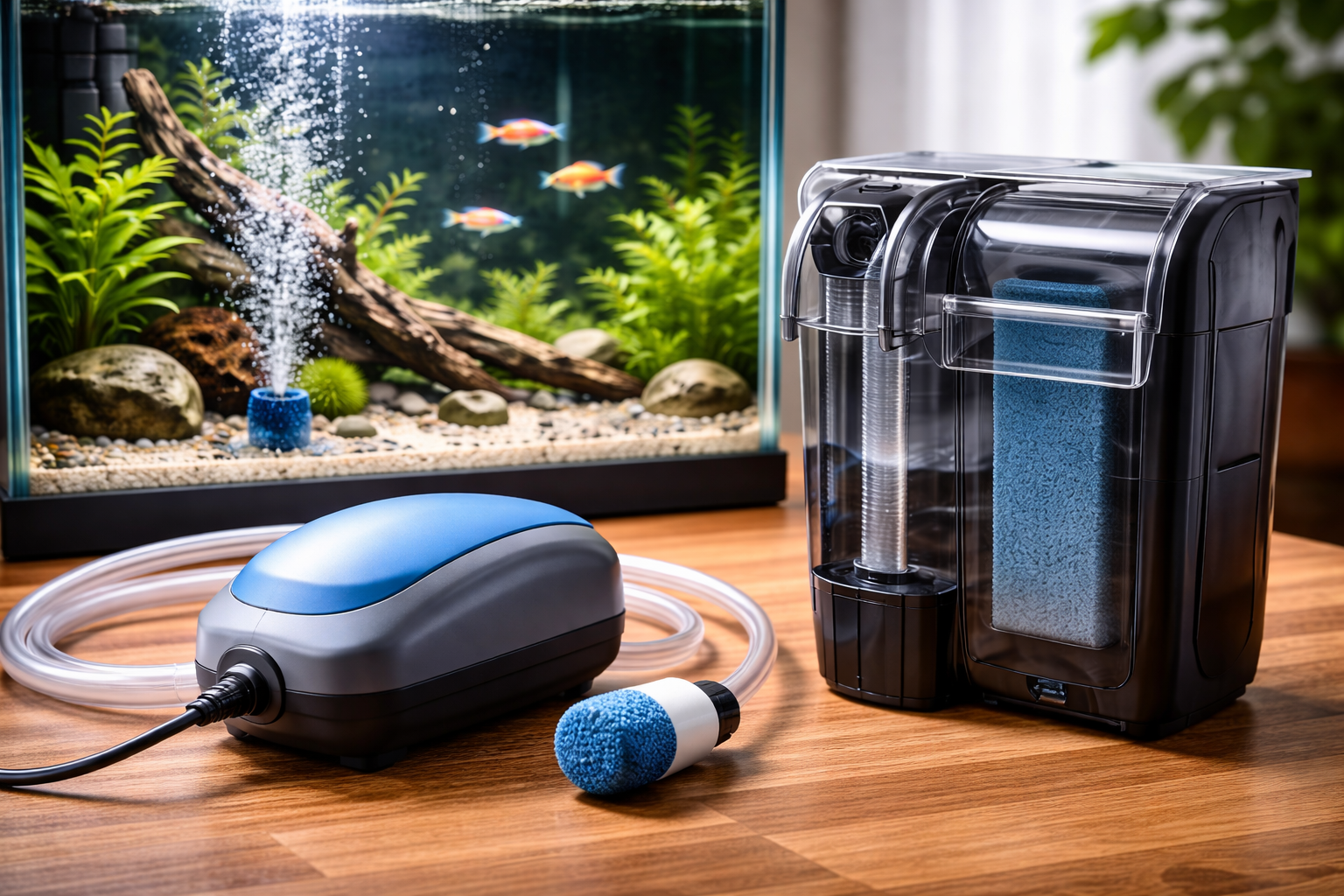
An air pump pushes air through tubing into the aquarium, typically using an air stone or sponge filter.
Primary Function: Aeration
Air pumps increase oxygen levels in the water by:
Creating surface agitation
Producing bubbles
Improving water circulation
They do not remove waste or toxins from the water directly.
Key Difference: Filtration vs Aeration
Here’s the simplest way to understand it:
Filters clean the water.
Air pumps oxygenate the water.
They perform different roles, though sometimes they work together.
Do You Need Both in Your Aquarium?
The answer depends on your setup.
In Most Standard Freshwater Tanks
You absolutely need a filter. You may not always need an air pump.
Modern filters often create enough surface movement to provide adequate oxygen exchange.
When an Air Pump Is Necessary
You may need an air pump if:
Your tank is heavily stocked
You have fish that require high oxygen levels
You’re running a sponge filter
You keep bottom-dwelling species
Water movement is minimal
Air pumps are especially helpful in warm water tanks because warm water holds less oxygen.
Types of Aquarium Filters
Understanding filter types helps clarify their importance.
Hang-On-Back (HOB) Filters
Easy to install
Ideal for beginners
Canister Filters
Powerful
Great for larger tanks
Internal Filters
Compact
Good for small tanks
Sponge Filters
Air-powered
Combine aeration and biological filtration
Notice that sponge filters actually use an air pump to function.
Types of Air Pumps
Air pumps are relatively simple devices.
Common Uses Include:
Powering sponge filters
Running air stones
Operating bubble decorations
Increasing oxygen during medication treatments
They are usually small, external devices placed outside the tank.
How Surface Agitation Affects Oxygen
Oxygen enters the aquarium primarily through surface exchange.
Filters often create water movement at the surface, which:
Promotes gas exchange
Releases carbon dioxide
Increases oxygen levels
In tanks with strong filters, additional air pumps may not be necessary.
Situations Where Filters Alone Are Enough
You may not need an air pump if:
Your filter output disturbs the surface well
Fish show no signs of oxygen stress
Tank temperature is stable
Stocking levels are moderate
Observe your fish — if they are not gasping at the surface, oxygen levels are likely adequate.
Situations Where Both Work Best Together
In some setups, combining both provides maximum stability.
Ideal for:
Large aquariums
Breeding tanks
Hospital tanks
Goldfish tanks
High-temperature setups
Using both improves redundancy and water quality.
Signs of Low Oxygen in Your Tank
Watch for:
Fish gasping at the surface
Rapid gill movement
Lethargic behavior
Poor circulation areas
If you notice these signs, consider adding an air pump.
Energy Usage Comparison
Filters typically consume more energy because they run continuously and power internal motors.
Air pumps use less electricity but still require continuous operation if needed.
Both are generally energy-efficient in modern models.
Noise Considerations
Filters can produce water-flow noise.
Air pumps may create humming or vibration sounds.
Placing equipment on soft padding reduces vibration noise.
Common Beginner Mistakes
Thinking an air pump replaces a filter
Running a tank without filtration
Turning off filters at night
Overstocking without increasing aeration
Remember: a filter is mandatory for most aquariums.
Freshwater vs Saltwater Differences
Freshwater Tanks
Often fine with just a good filter.
Saltwater Tanks
Require stronger filtration systems and sometimes additional aeration, especially in reef setups.
Budget Considerations
If you’re prioritizing equipment:
Filter (essential)
Heater (for tropical fish)
Lighting
Air pump (optional in many cases)
Always invest in a reliable filter first.
Quick Comparison Chart
Feature
Filter
Air Pump
Removes waste
Yes
No
Supports bacteria
Yes
Only if sponge filter
Adds oxygen
Indirectly
Yes
Essential
Yes
Sometimes
Moves water
Yes
Slightly
Final Thoughts
Air pumps and filters serve different but complementary roles in aquarium care.
Filters are essential for cleaning water and maintaining biological balance. Air pumps primarily improve oxygen levels and water movement.
In most beginner freshwater tanks, a good filter is enough. However, in certain situations — such as heavy stocking or high temperatures — adding an air pump enhances stability and fish health.
Understanding the difference helps you make smarter equipment decisions and build a thriving aquatic environment.
Clean water and proper oxygen levels are the foundation of happy, healthy fish. 🐠


 Accessories & Others
 Apparel
 Beds & Furniture
 Cages & Accessories
 Carriers & Strollers
 Doors, Gates & Ramps
 Flea & Tick Control
 Grooming
 Litter & Housebreaking
 Memorials & Funerary
 Accessories & Others
 Apparel
 Beds & Furniture
 Cages & Accessories
 Carriers & Strollers
 Cat Doors,Steps, Nets.
 Collars, Harnesses & leashes
 Flea & Tick Control
 Grooming
 Cages& Accessories
 Cow Mastitis Detectors
 Ear Tags
 Aquarium Accessories
 Aquarium Cleaners
 Aquarium Decor
 Aquarium Lights
 Aquarium Pumps & Filter
 Aquariums & Fish Bowls
 Automatic Feeders