Filtration is the heart of every aquarium. Without a proper filter, harmful toxins build up quickly, water becomes cloudy, and fish health declines. But when choosing a filter, beginners often face one big question:
Internal filter or external filter?
Both options keep your tank clean, but they work differently and suit different setups. In this complete guide, we’ll compare internal and external aquarium filters in detail — including performance, maintenance, cost, and best use cases — so you can choose the right one for your tank.
What Is an Internal Aquarium Filter?
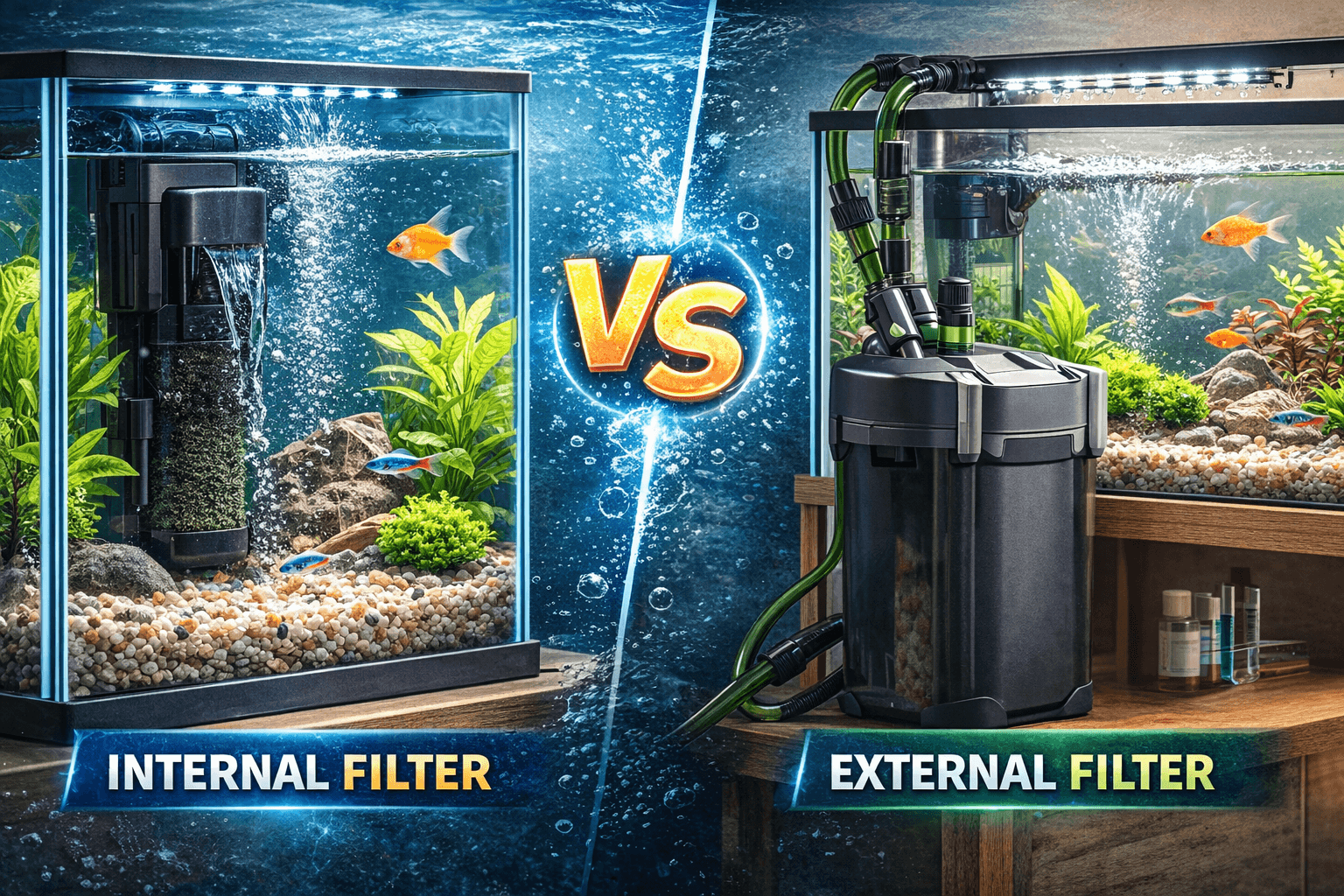
An internal filter sits inside the aquarium, usually attached to the glass with suction cups. It draws water in, passes it through filter media, and releases clean water back into the tank.
These filters are compact and simple to install.
How Internal Filters Work
Water is pulled into the filter unit.
It passes through sponge or cartridge media.
Clean water flows back into the tank.
Internal filters typically provide:
Mechanical filtration (removes debris)
Basic biological filtration
Sometimes chemical filtration (carbon)
What Is an External Aquarium Filter?
An external filter, often called a canister filter, sits outside the aquarium — usually under the tank in a cabinet. Water flows from the tank into the external unit, passes through multiple filtration stages, and returns clean.
External filters are more powerful and customizable.
How External Filters Work
Intake tube draws water out of the tank.
Water enters the canister.
It passes through layered media (sponge, ceramic rings, carbon, etc.).
Clean water is pumped back via an outlet hose.
They offer:
Strong mechanical filtration
Advanced biological filtration
Optional chemical filtration
Internal vs External Filters: Key Differences
Let’s break it down clearly.
1. Installation & Setup
Internal Filter
Very easy to install
Plug-and-play
No hoses required
Best for beginners
External Filter
Requires tubing setup
Must be placed below tank level
Takes more time to assemble
Winner for simplicity: Internal filter
2. Filtration Power
Internal Filter
Suitable for small tanks
Limited media space
Moderate flow strength
External Filter
Large media capacity
Strong water flow
Excellent for larger tanks
Winner for power: External filter
3. Tank Size Compatibility
Tank Size
Recommended Filter
5–20 gallons
Internal
20–40 gallons
Either
40+ gallons
External
Small tanks don’t need heavy filtration, but larger tanks benefit greatly from external systems.
4. Maintenance
Internal Filter
Requires frequent cleaning
Must reach inside tank
Can disturb fish
External Filter
Cleaned less frequently
Maintenance done outside tank
More convenient for large tanks
Winner for convenience: External filter
5. Noise Level
Internal filters are usually quiet but may produce vibration inside the tank.
External filters are typically very quiet, especially high-quality models.
Both can be silent if properly maintained.
6. Aesthetic Impact
Internal Filter
Visible inside the tank
Takes up swimming space
External Filter
Hidden outside
Cleaner, more natural tank look
If aesthetics matter, external filters win.
7. Cost Comparison
Internal Filter
Budget-friendly
Ideal for beginners
Low upfront cost
External Filter
More expensive
Long-term investment
Better for serious hobbyists
Winner for budget: Internal filter
Pros and Cons Summary
Internal Filters
Pros
✔ Affordable ✔ Easy to install ✔ Ideal for small tanks ✔ Beginner-friendly
Cons
✘ Limited filtration capacity ✘ Takes space inside tank ✘ Needs frequent cleaning
External Filters
Pros
✔ Powerful filtration ✔ Large media capacity ✔ Cleaner tank appearance ✔ Ideal for large aquariums
Cons
✘ Higher cost ✘ More complex setup ✘ Requires cabinet space
Which Filter Is Best for Beginners?
If you’re just starting:
Tank under 20 gallons → Choose internal
Tank over 30 gallons → Consider external
Planted aquarium → External preferred
Heavy fish stocking → External recommended
For most beginners with small freshwater tanks, an internal filter is more than enough.
Special Considerations
Planted Aquariums
External filters offer better flow control and biological stability for planted tanks.
Goldfish Tanks
Goldfish produce heavy waste. External filters are better for managing bio-load.
Nano Tanks
Internal filters are perfect for compact setups.
Marine Aquariums
External canister filters or sump systems are preferred for saltwater.
Maintenance Tips for Both Filters
Regardless of filter type:
Clean filter media in tank water (not tap water)
Never replace all media at once
Check impeller monthly
Ensure proper flow rate
Replace carbon as recommended
Regular maintenance keeps fish healthy and water crystal clear.
Final Verdict: Internal vs External Aquarium Filters
There is no “one-size-fits-all” answer.
Choose internal filters if:
You have a small tank
You’re on a budget
You’re a beginner
You want easy setup
Choose external filters if:
You have a large aquarium
You want stronger filtration
You prefer a clean tank look
You plan long-term fishkeeping
The right filter depends on your tank size, fish type, and commitment level.
Conclusion
Both internal and external aquarium filters effectively maintain water quality. The key difference lies in power, capacity, convenience, and cost.
If you’re starting small, go internal. If you’re building a long-term aquatic ecosystem, go external.
A properly filtered tank means healthier fish, cleaner water, and a more enjoyable aquarium experience.


 Accessories & Others
 Apparel
 Beds & Furniture
 Cages & Accessories
 Carriers & Strollers
 Doors, Gates & Ramps
 Flea & Tick Control
 Grooming
 Litter & Housebreaking
 Memorials & Funerary
 Accessories & Others
 Apparel
 Beds & Furniture
 Cages & Accessories
 Carriers & Strollers
 Cat Doors,Steps, Nets.
 Collars, Harnesses & leashes
 Flea & Tick Control
 Grooming
 Cages& Accessories
 Cow Mastitis Detectors
 Ear Tags
 Aquarium Accessories
 Aquarium Cleaners
 Aquarium Decor
 Aquarium Lights
 Aquarium Pumps & Filter
 Aquariums & Fish Bowls
 Automatic Feeders