A fish net might seem like a simple aquarium tool—but choosing the wrong one can stress, injure, or even kill your fish. Whether you’re transferring fish, removing debris, or managing fry, the right net size and material make a huge difference.
In this complete buying guide, you’ll learn:
How to choose the correct fish net size
Which materials are safest for your fish
When to use fine vs coarse mesh
How to match nets to tank type and species
Maintenance and hygiene tips
Let’s make sure you pick the right tool for your aquarium.
Why Choosing the Right Fish Net Matters
Fish have delicate fins, scales, and slime coats. Poor-quality or incorrectly sized nets can:
Tear fins
Remove protective slime
Cause stress injuries
Damage delicate species
Make fish-catching harder
A proper net ensures safe handling and reduces stress during maintenance.
1️⃣ Fish Net Size Guide
Choosing the right size depends on:
Tank size
Fish size
Fish speed
Purpose (transfer, cleaning, breeding)
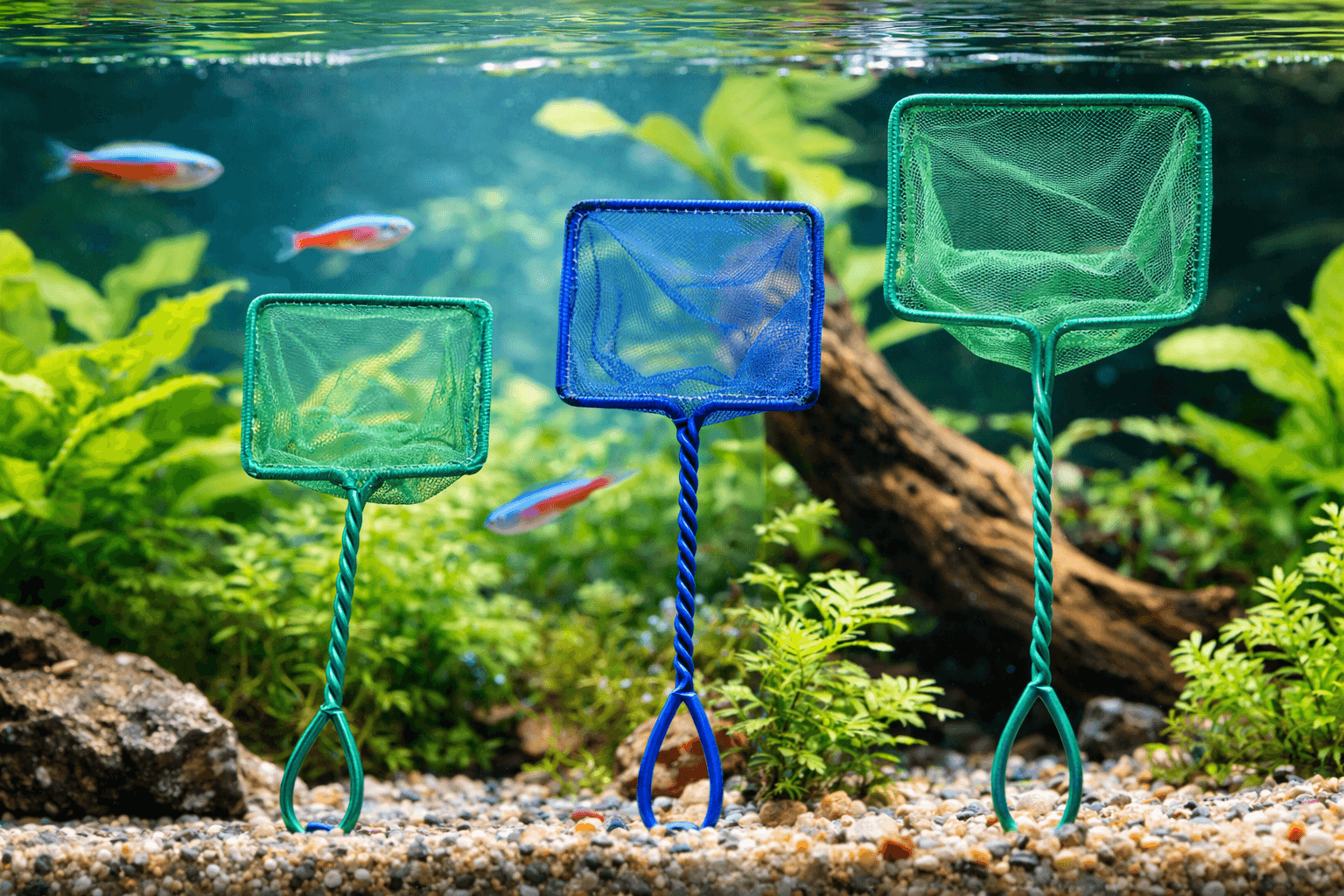
🔹 Small Nets (2–4 inches)
Best for:
Fry and baby fish
Small nano fish (like tetras, guppies)
Shrimp tanks
Small aquariums (5–20 gallons)
Advantages:
Better precision
Easy to maneuver in tight spaces
Less disturbance to plants
Avoid if:
You have medium or large fish
🔹 Medium Nets (5–8 inches)
Best for:
Community tanks
Most freshwater aquariums
Fish up to 4–5 inches
Advantages:
Balanced control
Versatile use
Good for general maintenance
This is the most commonly used size for average hobbyists.
🔹 Large Nets (8–12+ inches)
Best for:
Cichlids
Goldfish
Large freshwater fish
Saltwater species
Tanks over 55 gallons
Advantages:
Faster capture
Less chasing stress
Better control of larger fish
Avoid if:
You have small fry (they can slip through coarse mesh)
Handle Length Matters Too
Short handle:
Best for small tanks
Easier control
Long handle:
Ideal for deep tanks
Reduces arm submersion
Helpful for large aquariums
For deep tanks (over 18 inches), choose a longer handle to avoid splashing and stress.
2️⃣ Fish Net Material Guide
The material of the mesh is just as important as the size.
Nylon Mesh Nets
Most common option
Pros:
Affordable
Lightweight
Quick drying
Widely available
Cons:
Can snag delicate fins
May damage slime coat
Not ideal for sensitive fish
Best for: Hardy freshwater fish and general maintenance.
Fine Mesh Nets
Fine mesh nets have tightly woven material.
Pros:
Gentle on fry
Ideal for shrimp
Better for small fish
Cons:
Drains water slowly
Can increase handling time
Best for: Breeding tanks, nano aquariums, shrimp keepers.
Soft Net / Microfiber Nets
These are designed specifically for delicate species.
Pros:
Protect slime coat
Reduce fin tearing
Ideal for expensive fish
Cons:
Slightly more expensive
Requires gentle cleaning
Best for: Discus, bettas, angelfish, marine species.
Rubber-Coated Nets
Modern and increasingly popular.
Pros:
Extremely fish-safe
No scale snagging
Easy to clean
Durable
Cons:
Slightly heavier
Higher cost
Best for: Saltwater tanks, sensitive fish, premium setups.
Freshwater vs Saltwater Considerations
Freshwater Tanks
You can safely use:
Nylon nets
Medium mesh
Standard sizes
Unless keeping delicate species.
Saltwater Tanks
Strongly recommended:
Rubber-coated nets
Soft mesh nets
Saltwater fish are often more sensitive, and infections spread quickly.
Matching Net to Fish Type
Fish Type
Recommended Net
Fry
Small fine mesh
Shrimp
Fine mesh net
Guppies / Tetras
Small-medium soft net
Goldfish
Medium-large nylon
Cichlids
Large sturdy net
Discus
Soft microfiber net
Marine fish
Rubber-coated net
Common Fish Net Buying Mistakes
❌ Buying one net for all fish ❌ Using coarse mesh for fry ❌ Using oversized nets in small tanks ❌ Choosing cheap nets that rust ❌ Not disinfecting between tanks
Avoid these mistakes to keep fish safe.
Pro Tip: Keep Two Nets
Professional aquarists often use:
One large net
One small net
Using two nets makes catching fish easier and reduces stress.
It also helps separate quarantine and main tank equipment.
Hygiene & Maintenance Tips
Fish nets can carry bacteria and parasites. Always:
Rinse after use
Dry completely
Disinfect between tanks
Avoid cross-contamination
Replace damaged nets
If you keep multiple tanks, consider separate nets for each.
When to Replace Your Fish Net
Replace your net if:
Mesh tears
Frame rusts
Handle weakens
Edges become sharp
Coating peels
A damaged net is a risk to your fish.
Budget vs Premium Nets
Budget Nets:
Good for beginners
Fine for hardy fish
Premium Nets:
Better longevity
Safer for delicate species
Worth it for saltwater setups
If you keep expensive fish, invest in quality.
Final Buying Recommendations
If you’re just starting:
👉 Choose a medium-sized soft mesh net (5–6 inches) 👉 Add a small fine mesh net for fry or shrimp
If you run a large tank:
👉 Choose an 8–10 inch rubber-coated net with long handle
If you keep delicate fish:
👉 Go with microfiber or rubber-coated nets
The right fish net protects your fish, reduces stress, and makes maintenance easier.
Don’t treat it as a minor accessory—it’s an essential aquarium tool.


 Accessories & Others
 Apparel
 Beds & Furniture
 Cages & Accessories
 Carriers & Strollers
 Doors, Gates & Ramps
 Flea & Tick Control
 Grooming
 Litter & Housebreaking
 Memorials & Funerary
 Accessories & Others
 Apparel
 Beds & Furniture
 Cages & Accessories
 Carriers & Strollers
 Cat Doors,Steps, Nets.
 Collars, Harnesses & leashes
 Flea & Tick Control
 Grooming
 Cages& Accessories
 Cow Mastitis Detectors
 Ear Tags
 Aquarium Accessories
 Aquarium Cleaners
 Aquarium Decor
 Aquarium Lights
 Aquarium Pumps & Filter
 Aquariums & Fish Bowls
 Automatic Feeders